
Quick Answer: Commercial flat roof maintenance Long Island buildings need comes down to three habits: clear drainage, twice-yearly inspections, and catching seam or ponding problems early. TPO, EPDM and modified bitumen roofs all last 20–30 years with that routine — and fail in 10–15 without it. (As of October 2026.)
Long Island carries one of the densest concentrations of flat commercial roofs in New York — the Hauppauge and Bohemia industrial parks, the Route 110 office corridor, and retail strips across Nassau and Suffolk County. Add nor’easters, freeze-thaw cycles and salt air on the south shore, and a flat roof here simply works harder than one inland. This guide breaks down the three systems you’ll find under your feet, the two failure modes that cause most leaks, and the checklist property managers should run twice a year.
The Three Flat Roof Systems on Long Island Commercial Buildings
TPO (Thermoplastic Polyolefin)
The white, single-ply membrane you see on most newer warehouses and retail boxes. Seams are heat-welded on site, and the reflective white surface cuts summer cooling loads — a real advantage for big-box footprints. Typical lifespan: 20–30 years. Its weak points: seam welds and punctures from foot traffic and rooftop equipment service.
EPDM (Rubber Roofing)
The black synthetic rubber membrane, usually installed in sheets up to 50 feet wide — which means fewer seams to fail. EPDM stays flexible in cold weather, a genuine advantage in Long Island freeze-thaw, and holds the longest proven track record: 25–30+ years with maintenance. Its weak points: decades-long shrinkage that pulls at edges and terminations, and seam tapes or adhesives aging out before the field membrane does.
Modified Bitumen
The asphalt-based, two-ply rolled system, torch-applied or self-adhered, with a granule surface. It’s the toughest of the three under rooftop traffic — HVAC techs walking to units, satellite dishes, repeated service visits. Typical lifespan: around 20 years. Its weak points: open laps, surface blisters, and “alligatoring” — the cracked, dried skin that appears as the asphalt ages.
| System | Typical lifespan | Best suited to | #1 maintenance priority |
|---|---|---|---|
| TPO | 20–30 years | Warehouses, retail, high cooling loads | Seam weld integrity |
| EPDM | 25–30+ years | Durability on a budget, large simple roofs | Shrinkage at edges + seam adhesives |
| Modified bitumen | ~20 years | Heavy rooftop traffic, older buildings | Laps, blisters, flashing cement |
How Do You Fix Ponding Water on a Flat Roof?
Ponding water is standing water that remains 48 hours after rainfall ends — and it’s the single biggest threat to every flat roof system. Left alone, it accelerates membrane aging, grows vegetation, turns to ice in January freeze-thaw cycles, and — critically — most manufacturer warranties exclude damage where ponding is present.
The fix depends on the cause:
- Clogged drains or scuppers: the cheapest fix and the most common cause. Clear primary drains, overflow scuppers and gutters — twice a year minimum.
- Settled or compressed insulation: low spots where water collects. Fixed with crickets (tapered saddles) or a tapered insulation overlay that re-slopes the deck toward drains.
- Structural sag: a framing-level issue — needs a professional assessment before any membrane work.
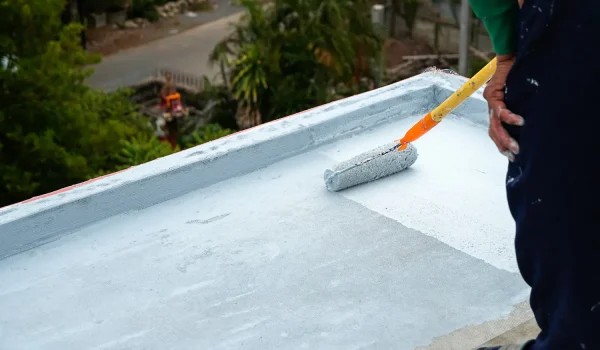
- Sound roof, chronic shallow ponding: a silicone restoration coating can handle standing water on an otherwise healthy membrane — far cheaper than replacement.
Seam Separation: What to Look For by System
Seams are where 80% of flat roof leaks start. Each system fails differently:
| System | Early warning signs | What’s happening |
|---|---|---|
| TPO | Fishmouths and wrinkles at laps; a seam that lifts with light probing | Heat weld failed or was contaminated during installation |
| EPDM | Seam tape edges lifting; membrane pulling back at parapets and corner details | Adhesive aging out or natural shrinkage tightening the sheet |
| Modified bitumen | Open laps, granule piles along seam lines, cracking lap cement | Lap cement drying out; surface aging past its service window |
One more signal worth checking from inside: a spike in HVAC costs. Water entering through a failed seam soaks the insulation board beneath the membrane, and wet insulation loses most of its R-value – your tenant’s electric bill often flags a roof leak before any stain appears.
The Bi-Annual Inspection Checklist for Property Managers
Run this twice a year – late fall (before snow load and freeze-thaw) and spring (after them) – plus a walk after every major nor’easter:
| Area | What to check |
|---|---|
| Drainage | 1. All drains and scuppers clear 2. Overflow scuppers open 3. Ponding areas photographed with a ruler for the log |
| Membrane field | 4. Seams and laps visually checked (probing by a pro) 5. Blisters, ridges, alligatoring 6. Punctures, cuts, dropped screws and branches 7. Open seams or fishmouths marked for repair |
| Flashings & penetrations | 8. Flashing at parapets, walls and equipment curbs — tight and sealed 9. Pipe boots and vent seals 10. Termination bars secure |
| Rooftop equipment | 11. HVAC curbs re-caulked, condensate lines draining, walk pads intact, cables and antennas anchored |
| Interior & records | 12. Top-floor ceilings for stains; log updated with photos, dates and any warranty terms |
That last row matters more than it looks: a dated photo log is what turns a warranty dispute or an insurance claim after a nor’easter from a fight into a formality.
When to Stop Walking and Call a Commercial Roofer
Property managers can and should do the visual pass. Call in a professional commercial roofing contractor when you see: interior water stains, ponding that persists past 48 hours on a recurring basis, open or probe-failed seams, spreading blisters, a membrane past year 15–20, or salt-air corrosion on south-shore flashings and rooftop unit curbs. On a 20,000+ sq ft warehouse roof, a small seam repair caught in October is a rounding error; the same seam found in March is a drywall and inventory claim.
Frequently Asked Questions
How often should a commercial flat roof be inspected in New York?
Which flat roof lasts longest: TPO, EPDM or modified bitumen?
Does ponding water void a flat roof warranty?
Can ponding water be fixed without replacing the roof?
What is the best flat roof system for a Long Island warehouse?
How much does commercial flat roof maintenance cost on Long Island?
Get a Commercial Roof Inspection Scheduled
Our team maintains TPO, EPDM and modified bitumen roofs across Nassau and Suffolk County – from Hauppauge warehouses to Route 110 office parks. See our commercial roofing services or call 516-727-6265 for a free roof assessment and a line-item maintenance plan.
